
The creative industry faces mounting pressure to innovate while addressing sustainability, AI disruption, and market saturation. At its core problem framing – defining challenges accurately before solving them – determines success. Without clear framing, solutions risk irrelevance or unintended consequences.
Why Problem Framing Matters
Creative leaders cite “staying relevant in a tech-driven, hyper-competitive market” as a top challenge. Misdiagnosing problems leads to wasted resources, especially when sustainability goals like reducing carbon footprints or ethical AI use are misaligned. For instance, design studios must balance client demands with ecoconscious practices, requiring precise problem scoping to avoid greenwashing or inefficiency.
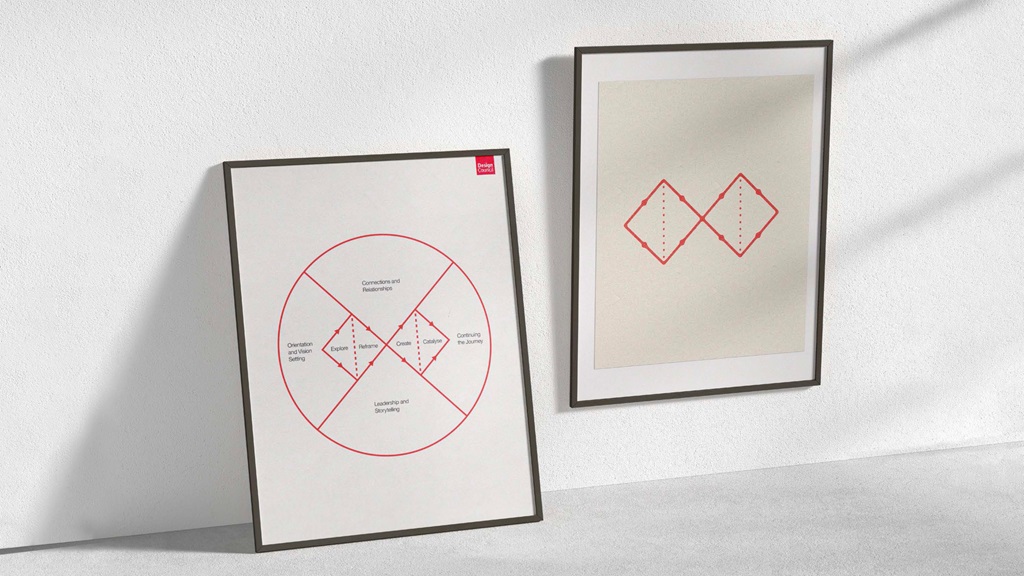
The Double Diamond Approach
Developed by the UK Design Council and refined for modern challenges, the Double Diamond method
structures problem-solving into four phases:
- Discovery: Divergent research to map stakeholder needs, environmental impacts, and market gaps. Example:
Streamlined life-cycle assessments (LCA) identify key sustainability pain points before ideation. - Definition: Convergent analysis to reframe findings into specific, actionable problems. This phase cuts
through “noise” like AI hype or vague ESG targets. - Development: Brainstorm solutions through prototyping and collaboration, ensuring ideas are both creative
and sustainable (e.g., modular designs for easier recycling). - Delivery: Test solutions rigorously, iterating based on user feedback and environmental metrics.
Sustainability Through Structure
The Double Diamond’s iterative process embeds sustainability by:
- Preventing Scope Creep: Early problem definition avoids solutions that exacerbate environmental or
social issues. - Data-Driven Decisions: Tools like LCA quantify impacts, ensuring eco-friendly choices aren’t
afterthoughts. - User-Centricity: Aligning solutions with evolving values (e.g., Gen Z’s demand for ethical practices)
builds long-term relevance.
To conclude we could claim that while navigating through current challenges – from AI ethics to circular design-the Double Diamond offers a roadmap to turn ambiguity into actionable, sustainable innovation. By framing problems correctly, creatives don’t just adapt to change; they drive it.
Citations:
https://www.creativeboom.com/insight/how-creative-leaders-are-preparing-for-2025/
https://www.creativeboom.com/insight/the-biggest-challenges-for-design-studios-in-2025-and-how-leaders-planto-tackle-them/
https://www.designcouncil.org.uk/our-resources/the-double-diamond/
https://www.core77.com/posts/21211/double-diamond-for-sustainable-strategy-participatory-lca-and-designthinking-by-stephen-clune-and-simon-lockrey-21211
https://www.linkedin.com/pulse/double-diamond-method-framework-creative-problem-solving-sheikh
https://thesustainableux.com/sustainable-ux-exploring-the-double-diamond-design-process/
https://claritee.io/blog/the-double-diamond-design-process-a-framework-for-creative-problem-solving/
Photo: https://www.designcouncil.org.uk/our-resources/the-double-diamond/
Share the article